
Catch Your People Communicating Well
Up Front: If you’re only talking with your team about communication when there’s a problem, you’re missing opportunities for growth, connection, and performance improvement. Your team’s ability to improve their communication depends on your ability to give them feedback about it. Redirect your attention to communication successes and give actionable positive feedback when you find them.
We tend to notice communication most when something goes awry. A small misunderstanding leads to a big argument with your spouse. Your kid does the exact opposite of what you thought you asked them to do. A harried barista gets your name, and possibly your coffee order, very wrong. In those frustrated moments, the importance of clear communication comes sharply into focus. But we rarely notice communication when it’s doing what it should.
This is true in the office, too. We readily spot the glitches: the urgent email that goes unanswered, the key stakeholder left out of the conversation, the message from leadership that falls flat.
Yet we tend to overlook communication when it’s working. Perhaps because it feels effortless in these situations, we forget that careful communication is happening in meetings that leave participants feeling inspired rather than drained, seamless transfers of information, and presentations that land. This pattern of inattention leads to missed opportunities for growth and performance improvement on your team.
How you give communication feedback matters
Your team’s ability to improve their communication depends on your ability to give them feedback about it. How you give feedback about communication shapes how your team feels about communication, and how they feel about communication determines how they will communicate.
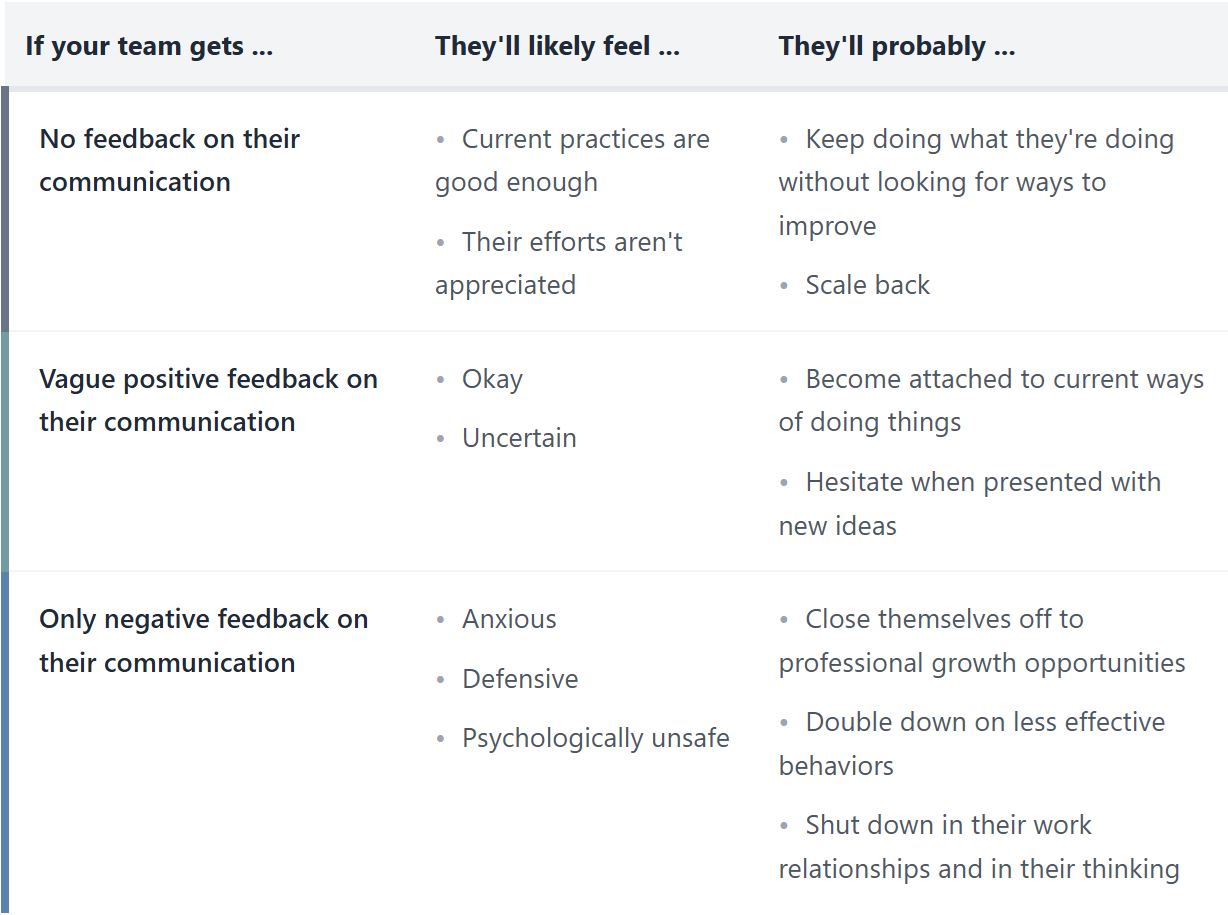
Patterns of communication feedback shape patterns of communication behavior.
Start with your most trusted communicators
The first, and most important, step toward improving communication on your team is catching people communicating well.
To begin, identify the communicators you trust the most. To whom do you tend to gravitate in conversation? Where do you look when you want a good listener or sound advice? If you need someone to deliver a high-stakes message, who comes to mind first? Make a list of specific behaviors these people exhibit.
Then, think about a time they used these skills in a way that helped you or the organization. Name what they did and name the benefit.
When you’ve got your example, tell them about it, and give them the specifics about their actions and the outcomes. (Not sure how to frame your feedback? Try this four-part formula.)
Practice this process a few times with your trusted communicators.
Expand the practice to the rest of your team
Once you’re comfortable sharing this kind of feedback, expand the practice to the rest of your team.
Start that expansion by looking for signs of great communication. These might include:
High-quality work delivered on time or early
Pairs or groups of people visibly engaged in focused, work-related conversation
Colleagues freely offering, or comfortably asking for, help
Meetings where participants are paying attention to others in the room and mostly ignoring their devices
People smiling and laughing
When you see these things happening, share what you noticed with the people involved, and explain how their actions impact the success of the team.
In your feedback, focus on observable behaviors rather than personal attributes. Statements like “You’re such a great listener” are lovely compliments, but don’t tell the receiver what they’ve done right or why it matters. Instead, you can say something like, “I appreciated that you turned away from your computer when I stopped by your office to chat about this project. That made me feel like you were truly listening.”
Meaningful feedback does more than make the receiver feel good, though that’s a delightful side effect. It also inspires them to commit to repeating the desired behavior and finding ways to maximize its benefit.
Feedback fosters learning and growth
Over time, you’ll become more attuned to communication successes, and more confident giving feedback about them. And the people on your team will get more accustomed to hearing from you in this way.
Once that happens, you can take your feedback further by following it with a question. You might ask:
How did you learn how to do that?
What process did you use to make that happen?
What can I do to make it easier for you to continue doing this?
Questions like this encourage reflection, which underpins the learning that leads to behavior change.
Eventually, this practice will become a habit, and your team conversations about communication will be ongoing and growth-oriented, rather than occasional and problem-focused. That dynamic makes it easier for everyone when you occasionally have to give negative feedback, as all leaders do.
We’ve all had the boss who seems just to be waiting for people to make mistakes and pouncing when they do. By regularly giving specific, positive feedback, you demonstrate that you’re paying careful attention all the time. In that way, you encourage your people to do well, even when they think no one is looking or listening.
